
In this article, I‘ll make a data-driven discussion on the most popular web browsers in the world. We will have a look at the top 10 Internet Browsers and also review the best web browsers by comparing important features.
Did you know that over 66% of the world’s population has access to the internet? According to Statista, there were 5.56 billion internet users worldwide in February 2025.
The most common ways to consume the internet are via (1) Web Browsers and (2) Social Media Apps.
Now, it is somewhat obvious that most users use the internet through default web browsers installed on various devices, i.e., computers or smartphones etc.
And if I am not wrong, you are also reading this article on an internet browser.
As day by day, the internet users graph is going up, and so are the chances of attack by malware, spammers, and other phishing activities, are increasing.
Theredore, you must use a safe and reliable web browser. This protects your digital credentials like passwords, security codes, and tracking information. It also protects your personal information.
Before checking how popular your favorite browser is, you may want to know how Wikipedia defines a web browser. You may also want to learn a bit about browser history.
If you don’t want to read this chronicle stuff, you may directly jump to the next paragraph.
What is a Web Browser?
So, What is called a Web Browser? According to Wikipedia,
A web browser (commonly referred to as a browser) is a software application for retrieving, presenting and traversing information resources on the World Wide Web. An information resource is identified by a Uniform Resource Identifier (URI/URL) and maybe a web page, image, video or other pieces of content. Hyperlinks present in resources enable users easily to navigate their browsers to related resources.
– Wikipedia
In simple words, a Web Browser is a Computer Application that allows the user to connect to the internet to access web pages, videos, images, or other information.
When was the first Web Browser Developed?
The first Web Browser was developed in 1990 by Tim Berners-Lee and is also known as TimBL. Initially, it was called WorldWideWeb and later was renamed as Nexus.
And in 1993, Marc Andreessen was the man who created a Web Browser with a graphical user interface called Mosaic later known as Netscape, which was the world’s first popular browser with a graphical user interface.
Now, let’s discuss what are the most popular web browsers in the world.

World’s Most Popular Web Browsers of 2025
Based on data from StatCounter, here is the worldwide Browser Market Share for the period of June 2024 to June 2025. The browser market has been dynamic, with various web browsers competing for dominance.
According to the data, Chrome, Safari, Edge, Firefox, and Samsung Internet continue to be the top 5 internet web browsers.

What Are the Top 10 Web Browsers in 2025?
Based on current market share data and user preferences, here is the list of the top 10 internet browsers in, 2025 that dominate the digital landscape:
- Google Chrome – 66.58% market share
- Apple Safari – 17.78% market share
- Microsoft Edge – 5.16% market share
- Mozilla Firefox – 2.59% market share
- Samsung Internet – 2.30% market share
- Opera – 2.09% market share
- UC Browser – 0.91% market share
- Android – 0.69% market share
- Yandex Browser – 0.38% market share
- Other Browsers – 1.53% market share
When you talk about surfing the web, Chrome is the undisputed king, as always. The web browser from search engine giant Google dominates the world with over 66.58% share. More than half of internet users worldwide choose Chrome. It is fast, secure, has many extensions, and works well with Google services.
Safari comes in second, but it is not just any runner-up. It is the heart of browsing for all Apple device users due to its optimization for macOS and iOS. With its 17.78% market share, Safari shows that it is loved for its clean design and its respect for user privacy. If you are using an Apple device, Safari is tailored for you.
I have Edge in the third spot. Microsoft’s Edge has been gaining a steady following with a market share of 5.16%. It has gained traction by offering a Chromium-based engine, improved performance, and compatibility with Chrome extensions. It is well-integrated with Windows and offers good performance.
Firefox might not be as big as it once was, but it is still a top choice for many. It has an internet browser share of 2.59% because it values your privacy and is open source. For those who care about an open web and want to keep their browsing to themselves, Firefox is a solid option.
Samsung Internet, specifically designed for Samsung devices, holds 2.3%. This default browser is handy and tightly integrated with other Samsung apps and services. If you have a Samsung device, you can definitely go with this default browser.
Opera stands strong in the sixth position. It might have a smaller slice of the pie at 2.09%, but it boasts great features like a free VPN and an ad blocker. For someone looking for a browser with built-in perks, Opera could be the right pick.
In seventh place, we have UC Browser, holding onto 0.91%. It is popular for its data-saving capabilities and fast loading times. If you are on a limited data plan or need a zippy browsing experience, UC Browser could be what you need.
The default browser on Android devices has a market share of 0.69%. It is simple and does the job for Android users who do not want complexity. It comes pre-installed in a few versions of vanilla Android, and it is okay if you just want to get online without any fuss.
Yandex Browser captures the ninth place with 0.38%. It is mostly popular in its native country, Russia, and Russian-speaking countries. The browser claims to make things easier and safer for its users and offers highly integrated Yandex services, including Turbo mode and DNS Spoofing Protection.
Lastly, we group all the other players, like 360 Safe Browser, Brave Browser, QQ Browser, and IE, under “Others,” making up a combined market share of 1.53%. These browsers are for specific needs and offer unique browsing tools. You can find some hidden gems for your niche requirements.
Each browser on this list of top 10 internet browsers has its reasons for being where it is on the list. You can find a browser that fits your needs. It may be for speed, simplicity, privacy, default integration, or device compatibility.
In this section, let’s have a look at who’s leading the pack in the world of web browsers for desktops, tablets, and mobile phones. I have compiled the market share data of the top 10 browsers in all three categories in the table below.
Data Source: Statcounter,
Data Duration: June 2024 to June 2025,
Categories: Web Browser Desktop, Tablet, and Mobile.
Desktop Stats:
| # | Browser | Market Share % |
|---|---|---|
| 1 | Chrome | 65.47% |
| 2 | Edge | 13.49% |
| 3 | Safari | 8.67% |
| 4 | Firefox | 6.31% |
| 5 | Opera | 2.82% |
| 6 | Other | 3.24% |
Tablet Stats:
| # | Browser | Market Share % |
|---|---|---|
| 1 | Chrome | 49.12% |
| 2 | Safari | 33.13% |
| 3 | Android | 14.91% |
| 4 | Edge | 0.97% |
| 5 | Opera | 0.84% |
| 6 | Other | 1.03% |
Mobile Stats:
| # | Browser | Market Share % |
|---|---|---|
| 1 | Chrome | 67.79% |
| 2 | Safari | 22.57% |
| 3 | Samsung Internet | 3.70% |
| 4 | Opera | 1.70% |
| 5 | UC Browser | 1.44% |
| 6 | Android | 0.65% |
| 7 | Firefox | 0.53% |
| 8 | Edge | 0.46% |
| 9 | QQ Browser | 0.38% |
| 10 | Others | 0.78% |
Let’s analyze the market share of desktop, tablet, and mobile web browsers based on the data provided in the table above.
Most Popular Web Browsers of 2025 (Reviewed & Compared)
These statistics of market share clearly indicate the uses and preferences of the users for Internet Browsers. Further, let us take a closer look at the standout features of the top 10 web browsers for desktop and mobile devices in the web browser market.
Nowadays, there is not much difference in the basic engine of desktop and mobile web browsers. Whether we are talking about speed, design, or security, these browsers are always evolving. They listen to what features we want and deliver them, especially when it comes to online safety.
Safety is a big deal when you are surfing the web. Thankfully, most of these popular internet browsers, like Google Chrome, Safari, Edge, and Firefox, are leading the pack.
They have been called out for their strong security by research from places like Accuvant Labs, Sandbox, and SunSpider.
Many browsers, including favorites like Chrome and Firefox, share their roots with an open-source project known as Chromium. Google plays a huge role in keeping Chromium safe and up-to-date.
This means that if a browser is built on Chromium, it gets all the latest security fixes that Chrome does.
Plus, these browsers can use all the Chrome Extensions without any trouble.
Now, let us talk about Safari. Apple’s team works on Safari, making sure it is secure. Since Safari runs on macOS, which is based on Linux, it faces fewer risks from viruses.
This makes Safari a strong contender in the browser security game, too.
Whether you are on a desktop or mobile, choosing the right browser matters. It is all about finding that perfect mix of speed, convenience, and security.
Popular Desktop Browsers – 2025

- Chrome continues to dominate the desktop browser market with a substantial share of 65.47%. Its closest competitor, Edge, trails behind with 13.49%, maintaining its stronghold among Windows users.
- Safari and Firefox secure the third and fourth positions, holding 8.67% and 6.31% of the desktop market share, respectively. Both browsers appeal to users who prefer flexibility and privacy features.
- Opera is mainly a gaming browser. It appears in desktop stats with a 2.82% share, showing more cross-platform use.
- Lesser-known browsers like UC Browser, Android Browser, Yandex Browser, and QQ Browser make up a small part of the desktop market. Together, they account for about 3.24%.
Popular Tablet Browsers – 2025

- Chrome leads the tablet browser market with a 49.12% share, offering strong performance, cross-device sync, and smooth integration with Android-based tablets.
- Safari holds a solid second place at 33.13%, largely due to its dominance on iPads and its seamless functionality within the Apple ecosystem.
- Android Browser follows with 14.91%, typically found on older tablets or custom Android OS devices, where users value lightweight performance.
- Other browsers like Edge, Opera, and various niche options account for 2.84% of the tablet browsing market combined.
Popular Mobile Browsers – 2025

- Chrome leads the mobile browser market with a dominant 67.79% share, offering excellent performance and deep integration across Android devices and Google services.
- Safari comes in second at 22.57%, maintaining its stronghold among iOS users due to smooth performance, privacy controls, and system-level efficiency.
- Samsung Internet holds third place with 3.70%, known for its robust privacy settings, built-in ad blocker, and user-friendly customization options.
- Other browsers like Opera, UC Browser, Firefox, Edge, and QQ Browser make up 5.94%. They serve specific preferences, need for light performance, or niche regions.
Key Takeaway
- Chrome emerges as the clear leader across all three device categories, indicating its cross-device popularity, user preference, and satisfaction.
- Safari is a strong contender in tablets and mobile devices, showcasing Apple’s stronghold in these segments and its popularity among Apple device users.
- Firefox, Edge, and Samsung Internet maintain their positions across different devices, albeit with varying market shares.
How to Choose the Best Web Browser for Your Use
Primarily, you should look for the five basic categories while assessing a web browser.
- Speed – The web browser should render web pages in no time; it should be lightning fast.
- Privacy and Security – It should offer data privacy features and should have a security shield for viruses/malware.
- Basic Browsing Features – Tabbed Browsing, Bookmarks Manager, AutoFill, Auto search from the address bar, Password Manager, Download Manager, One-click clear browser cache, cookies removal, etc.
- Updates and Support – The developer should support the development of the web browser for the long term and should provide frequent updates to improve security and performance.
- Extensions/Plugins – It should offer a repository of various extensions developed by third parties.
Note – In the case of mobile web browsers, you should eliminate the last category, as most mobile web browsers do not offer extensions.
So, without any further ado, we’ll review and compare the best web browsers in the world.
Top 10 Web Browsers Comparison 2025
Let’s take a look at an overview of the unique characteristics and current popular features of the world’s top 10 web browsers, along with a comparison of their speed tests.
| Feature | Chrome | Safari | Edge | Firefox | Samsung Internet | Opera | Brave | Vivaldi | Tor | UC |
|---|---|---|---|---|---|---|---|---|---|---|
| Built-in VPN | ✖ | ✖ | 5 GB/month free | ✖ | ✖ | Unlimited | Paid add-on | Proton VPN integration | Requires external | ✖ |
| AI Assistant | Gemini Nano | On-device ML for tracker blocking | Copilot sidebar | Firefox View + no native AI | ✖ | Aria | Leo Chat beta | — | — | ✖ |
| Ad-block native | ✖ | ✖ | ✖ | ✖ | ✖ | ✔ | ✔ (Shields) | ✔ | Limited (NoScript) | ✖ |
| Web3 Wallet | ✖ | ✖ | ✖ | ✖ | ✖ | Crypto Wallet | BAT rewards | ✖ | ✖ | ✖ |
| Speedometer v3 | 37.8 | 38.7 | 35.1 | 34.6 | 33.9 | 34.3 | 34.0 | 33.8 | 30.5 | 29.1 |
| Update Cadence | 4-weeks | 4-weeks (OS-tied) | 4-weeks | 4-weeks (Rapid) / 12-months ESR | 8-weeks | 3-weeks | 3-weeks | 6-weeks | 6-weeks | Irregular |
This is a vendor-reported internal benchmark; independent data is scarce.
1. Chrome

Google Chrome remains the most widely used browser with 68.58% market share across both desktop and mobile devices, known for its speed, simplicity, and extensive support for web extensions.
Its seamless syncing across devices and operating systems, including Android via Google Play, makes it especially popular for users within the Google ecosystem.
Chrome supports advanced tools like custom keyboard shortcuts and split-screen layout for multitasking on supported platforms. With strong Content Security Policy enforcement, Chrome is also a leader in browser security.
Chrome leads global usage and web compatibility. Its regional market share varies slightly by country.
Key Features:
- Lightning-fast performance with V8 JavaScript engine
- Seamless sync across devices and platforms
- Extensive extension library with 190,000+ add-ons
- AI integration with Gemini Nano APIs for smart browsing
- Developer-friendly tools for web professionals
Chrome’s Speedometer v3 score of 37.8 and JetStream score of 353.6 make it one of the fastest browsers available. However, it’s known for high memory usage and limited privacy features compared to alternatives.
2. Safari
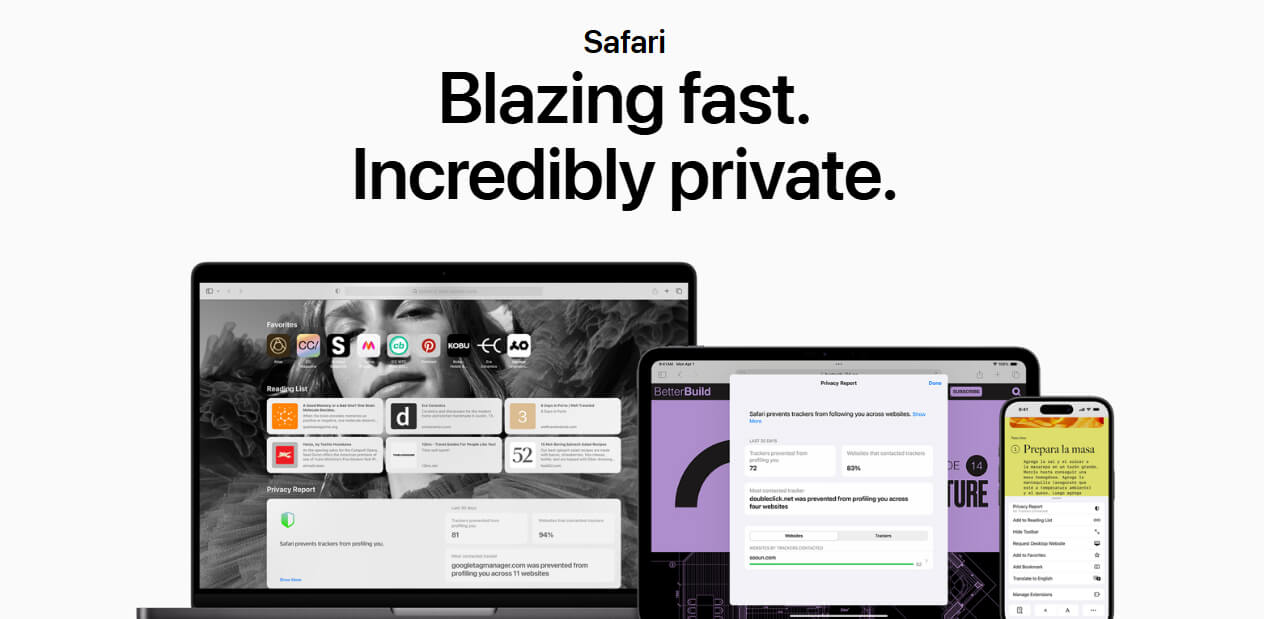
Safari holds 17.78% market share. Safari is Apple’s default browser for macOS and iOS, optimized for performance and energy efficiency on Apple hardware.
It offers a clean interface, fast page loading, and strong content security policy enforcement that helps protect against malicious sites.
Safari also supports split-screen layout on iPads and custom keyboard shortcuts on Macs, improving the multitasking experience for Apple users.
While its global regional market share is second to Chrome, Safari dominates on mobile devices in countries with high iPhone adoption.
Its seamless integration with iCloud makes syncing tabs and bookmarks effortless across Apple devices.
Why Safari Stands Out:
- Best battery life – 17 hours streaming on MacBook Air vs 14 hours in Chrome
- Intelligent Tracking Prevention blocks cross-site tracking
- WebKit engine optimized for Apple silicon
- Locked private tabs for enhanced security
- Automatic HTTPS upgrades for safer browsing
Safari scores highest in privacy protection and energy efficiency tests, making it the best browser for Mac users. Its major limitation is availability only on Apple devices.
3. Edge

Microsoft Edge is a modern web browser developed by Microsoft as a direct successor to Internet Explorer. Edge captures 13.49% of the desktop market share, making it the second-largest desktop browser after Chrome.
It integrates tightly with Microsoft Windows; however, available for other operating systems as well. It offers smooth performance, strong privacy settings, and many productivity tools.
Features like tab groups, split screen, and Speed Dial help users manage multiple tasks with ease. Edge is based on the Chromium engine, which means it supports most web standards while maintaining a clean interface.
Microsoft Edge has advanced AI features. It includes tools like Copilot. These features are ready to use right after installation.
It’s ideal for users who want fast browsing with built-in Microsoft ecosystem benefits.
Edge’s Competitive Advantages:
- Copilot AI assistant for content summarization and email drafting
- Sleeping tabs reduce memory usage by up to 83%
- 5GB free VPN per month for privacy protection
- 4K Netflix streaming support
- Startup Boost for faster launch times
Its AI features and resource efficiency make it ideal for productivity-focused users.
4. Firefox

Firefox is a well-known open-source browser developed by Mozilla. It maintains a 2.59% market share, popular for its emphasis on transparency, speed, privacy protections, and its use by web developers.
It includes advanced privacy settings, built-in tracking prevention, and flexible support for web extensions.
Firefox supports custom keyboard shortcuts, tab pinning, and multi-account containers. It is ideal for users who want both security and control.
Firefox is available on desktop and mobile devices. It offers a consistent user experience across platforms.
Its commitment to open standards and user-first design continues to attract privacy-conscious web users worldwide.
Firefox’s Privacy Features:
- Enhanced Tracking Protection blocks trackers by default
- CRLite certificate revocation for faster, private security checks
- HTTPS-by-default browsing for all connections
- Gecko engine is independent of Chromium
- Local password storage without cloud sync
Firefox is the best privacy browser for users who prioritize data protection and browser independence. Its rapid security response includes patching zero-day vulnerabilities within 48 hours.
5. Samsung Internet

Samsung Internet is a mobile-focused browser built on Chromium and optimized for Galaxy smartphones and Android mobile devices. Samsung Internet holds 2.30% overall share but 3.7% of mobile browsing, making it a significant mobile browser choice.
It offers a clean interface, fast performance, and a variety of user-centric features like privacy protections, ad blockers, and secure browsing modes.
It also supports split-screen layout and custom extensions, making it highly functional for multitasking on large-screen phones and tablets.
With regular updates via the Google Play Store, Samsung Internet continues to evolve as a powerful alternative to Chrome on Android devices.
Mobile-First Features:
- Built-in ad blocker for cleaner browsing
- QR code sharing for easy link transfer
- Dark mode and customizable themes
- Video assistant for enhanced media playback
- Smart anti-tracking protection
Samsung Internet is pre-installed on Galaxy devices and offers data compression features similar to UC Browser for reduced mobile data usage.
6. Opera

Opera maintains a 2.09% market share with its innovative features and gaming-focused variant, Opera GX.
Opera is a feature-rich browser built on Chromium, offering a balance between performance, customization, and built-in tools. It includes a free VPN, ad blocker, and battery saver mode, making it ideal for both privacy-focused and mobile users.
The Speed Dial homepage, tab groups, and sidebar integrations help improve user experience across desktop and mobile devices.
Opera also supports web extensions and has recently introduced AI features such as a built-in browser assistant to help with summarizing and searching.
It’s a solid alternative for users seeking smart browsing tools in a lightweight package.
Opera’s Unique Offerings:
- Free unlimited VPN built into the browser
- Aria AI assistant for contextual help and content generation
- Built-in ad blocker and tracker protection
- Crypto wallet for Web3 browsing
- Workspaces for organized tab management
Opera targets power users and gamers with specialized features that aren’t available in mainstream browsers.
7. UC Browser

UC Browser is a lightweight browser originally developed for mobile platforms, known for its fast loading speeds and data compression technology.
UC Browser holds 0.91% global share, primarily in emerging markets where data compression is crucial.
It is especially popular among users with limited bandwidth, as it uses cloud acceleration to reduce page size during web browsing.
The browser offers a simple interface, built-in privacy settings, and support for basic features like bookmark manager and tabbed browsing.
While it lacks advanced tools found in more modern browsers, UC Browser remains a go-to option for users who prioritize speed and minimal resource usage.
UC Browser’s Strengths:
- 60% data compression through proxy servers
- Fast download manager for large files
- Night mode for comfortable browsing
- Cloud sync across devices
- Popular in the Indian and Chinese markets
However, UC Browser faces security concerns and irregular updates, making it less suitable for privacy-conscious users.
9. Yandex Browser

Yandex Browser is a Chromium-based browser developed by Russia’s largest tech company.
Yandex Browser holds a modest 0.60% global market share but commands a significant presence in Russia and Eastern Europe, making it the second most popular browser in Russia with 21.5% market share
It offers a familiar browsing experience with added focus on local performance and built-in privacy protections.
One of its standout features is Turbo Mode, which helps speed up page loading on slower connections. The browser also includes a cookie banner blocker and other tools aimed at improving user control during web browsing.
While its regional market share is strongest in Russia and nearby countries, Yandex Browser remains a niche choice globally.
Key Features:
- Turbo Mode speeds up browsing via page compression
- SmartBox combines the search and address bar with predictive results
- Protect Technology guards against malicious sites and phishing
- Built-in ad blocker with third-party blocking app integration
- Data compression to reduce bandwidth usage on mobile
Yandex Browser’s Protect system provides real-time security checks against malicious sites, but it also collects user data, raising privacy concerns. Its activities are not fully verifiable like privacy-focused, open-source browsers.
10. Brave Browser

Brave is a privacy-focused web browser built on the Chromium engine, designed to deliver a faster, more secure, and ad-free web browsing experience. Brave has grown rapidly to a a 0.90% market share by focusing on privacy by default and user rewards.
It has powerful built-in privacy features. These include automatic blocking of ads, trackers, fingerprinting, and cookie consent pop-ups. It does not require third-party extensions.
What truly sets Brave apart is its unique integration with the crypto ecosystem through the BAT token (Basic Attention Token). Users can opt in to view privacy-respecting ads and earn BAT rewards in return.
These tokens can be used to support content creators, tip websites, or convert into crypto, offering a monetized, user-first browsing model.
In terms of performance, Brave is one of the fastest browsers available, which is quicker than traditional browsers like Chrome and Safari.
Its lightweight design, strong privacy settings, and clutter-free interface make it an ideal choice for users who value speed, privacy, and control over their data.
Brave’s Revolutionary Approach:
- Blocks ads and trackers automatically
- HTTPS Everywhere upgrades all connections
- Tor integration for anonymous browsing
- BAT cryptocurrency rewards for viewing ads
- 60% faster page loading due to ad blocking
Brave is the best privacy browser for users who want built-in protection without installing extensions. Its Brave Rewards system pays users in Basic Attention Tokens (BAT) for opt-in advertising.
11. Tor Browser

Tor Browser is made for anonymous browsing and maximum privacy protections. Tor Browser maintains a 0.11% share but plays a crucial role in online privacy and censorship circumvention.
It routes traffic through the Tor network, which hides your IP address and prevents websites, trackers, or even ISPs from knowing what you’re doing online.
Unlike most desktop browsers, Tor focuses almost entirely on privacy rather than convenience or speed.
It blocks scripts, disables trackers, and even isolates cookies after every session. This can slightly impact performance, but the trade-off benefits users who need stronger protection than standard privacy modes offer.
The browser version is available for Windows, macOS, and Linux, and while there is an Android app, the mobile experience is more limited.
Tor does not use standard search results by default, instead connecting you to search engines that respect anonymity.
Tor Browser is not good for everyday browsing or heavy media use. It is the top choice for users who need complete privacy, especially for restricted or sensitive websites.
There is an Android version of Tor available if you need to have full privacy while browsing on your mobile phone, too.
Tor’s Privacy Arsenal:
- Multi-hop onion routing for IP masking
- Built-in anti-fingerprinting protection
- Blocked JavaScript by default
- No browsing history storage
- Circumvents censorship in restricted regions
Tor is the most secure browser for users requiring maximum anonymity, though it sacrifices speed for privacy.
12. Vivaldi
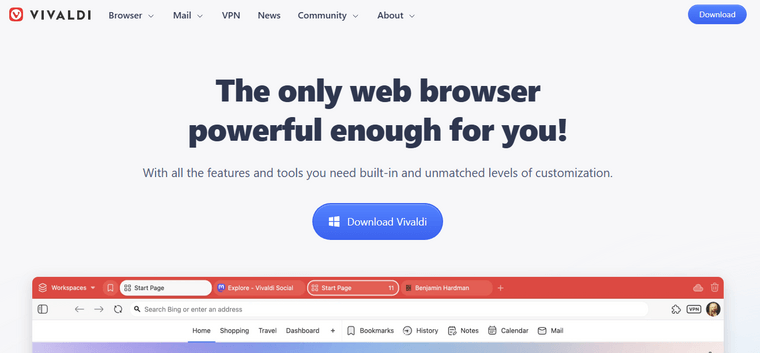
Vivaldi is a desktop browser built for users who want flexibility, privacy, and deep customization. Vivaldi appeals to power users with a 0.18% market share and extensive customization options.
It offers features like tab groups, a well-organized bookmark manager, and a speed dial homepage that helps improve daily web browsing flow. Both the Android and iOS versions carry over many of these tools, ensuring a consistent user experience across devices.
Unlike many competitors, Vivaldi has chosen not to follow the current wave of browser-based AI tools.
While others add AI chatbots or writing assistants, Vivaldi rejects this trend. It worries about data collection and weaker privacy protections.
This decision aligns with its long-standing focus on giving users control and minimizing surveillance. The latest browser version continues to focus on privacy, with built-in ad and tracker blocking, support for custom privacy settings, and secure syncing.
Vivaldi’s Power Features:
- Tab stacking and tab tiling for organization
- Built-in email client and calendar
- Mouse gestures for navigation
- Per-site CSS customization
- Command chains for automation
Vivaldi is the best browser for customization and appeals to users who want complete control over their browsing experience.
Our Recommendations: Which Internet Browser You Should Use
Based on our intensive tests and usage while reviewing the popular browsers, we have recommendations for everyone.
For Everyday Users
- Privacy-first: Choose Brave or Firefox for built-in tracker blocking and minimal telemetry.
- Battery-centric: Safari remains the most energy-efficient on Apple silicon devices.
- AI workflows: Edge Copilot and Chrome Gemini deliver the deepest assistant integrations for research and drafting tasks.
- For Speed and Performance: Google Chrome remains the fastest web browser with excellent cross-platform compatibility.
- For Customization: Vivaldi and Opera give power users complete control over their browsing experience
Enterprises
- Standardize on Chrome LTS or Edge Stable for rapid patching and predictable group-policy management.
- Enforce ESR channels for Firefox-dependent intranets to reduce breakage from rapid releases.
Developers & QA
- Test across Blink, WebKit, and Gecko to avoid engine-specific assumptions. This is important for privacy-affected storage APIs.
- Benchmark WebAssembly code separately on Safari and Chrome—their JIT strategies diverge under M-series CPUs.
Frequently Asked Questions
Next, let’s see some frequently asked questions regarding the topic.
What Makes Google Chrome The Most Popular Browser Among Internet Users?
Google Chrome continues to lead due to its lightning-fast performance, user-friendly design, and a massive library of third-party extensions. For internet users seeking seamless cross-device web browsing, Chrome remains the go-to choice.
Why Is Samsung Internet Gaining Popularity On Android Devices?
Samsung Internet stands out for its smooth performance, advanced privacy settings, and native support for ad-blocking extensions. It’s especially popular among Android users for offering a clean and secure mobile web browsing experience.
Does Mozilla Firefox Still Offer Better Privacy Benefits In 2025?
Mozilla Firefox still focuses on privacy. It has Enhanced Tracking Protection, strict privacy settings, and supports cookie banner blocker extensions. It’s a top pick for users who value online anonymity.
Is Apple Safari Only Available On Apple Devices?
Apple Safari is the default browser on all iPhones, iPads, and Macs. The Windows version of Safari has been discontinued. The macOS version remains powerful and focused on privacy. It integrates smoothly into the Apple ecosystem.
What Is The Chromium Engine, And Which Browsers Use It?
The Chromium engine is an open-source web engine used by popular browsers like Google Chrome, Microsoft Edge, Brave, and Opera. It powers modern web browsing with speed, stability, and wide support for third-party extensions.
What Is The BAT Token And How Is It Tied To The Crypto Ecosystem?
The BAT token (Basic Attention Token) is integrated into the Brave browser’s crypto ecosystem. Users can earn BAT by opting in to view ads and can support content creators directly, offering privacy-friendly monetization for web browsing.
Conclusion
Our analysis shows Google Chrome is the top choice for most internet users. It offers excellent performance, syncing across devices, and a large library of third-party extensions.
Apple Safari is the best choice for users in the Apple ecosystem. It offers excellent privacy features and saves battery, especially on macOS.
Microsoft Edge, built on the Chromium engine, has matured into a fast, reliable browser with strong integration for Windows users and support for modern tools like password managers.
Mozilla Firefox is a strong choice for users who value privacy most. It offers highly customizable privacy settings and strong tracking protection.
Samsung Internet is rising in mobile browser rankings. It has a smooth interface, ad-blocking features, and is optimized for Android devices.
So, depending on your preferences and requirements, you can choose a browser.


Great post. I think it’s interesting how in the USA, at least in the IT world, everyone criticizes IE. Yet in the rest of the world it is clearly still the leading browser. And not just by a little bit – we’re talking 3 times that of Chrome and Firefox!
Nice job on this.
Tim, glad you found it informative. Thanks for the great feedback 🙂
That’s a great pick up from best web browsers. My favorite is Brave Browser.
Thanks for this overview, gives me a good high level appreciation of the browsers out there. Can I check with you on the source for the statistics for the desktop and mobile browsers market share? Thanks in advance
Hi, can you advise the sources for the statistics for the market share?
It is StatCounter, you can find the link in the article.
I found this review really insightful! I’ve been using Chrome for years, but this article made me consider trying out some of the other browsers. Thanks for the detailed analysis.
Hey, It was super interesting! I mostly use Chrome because it’s fast and easy, but it was cool to learn about other options like Safari, Firefox, and Edge. Thanks for sharing!
Great job. The post was very useful and Informative.Thank you.
Great post.